
Use Cases
Use caseIoT device identity
Explore device-attributed readings with calibration history, key-lifecycle controls and proportionate telemetry sharing.
Explore use cases ↗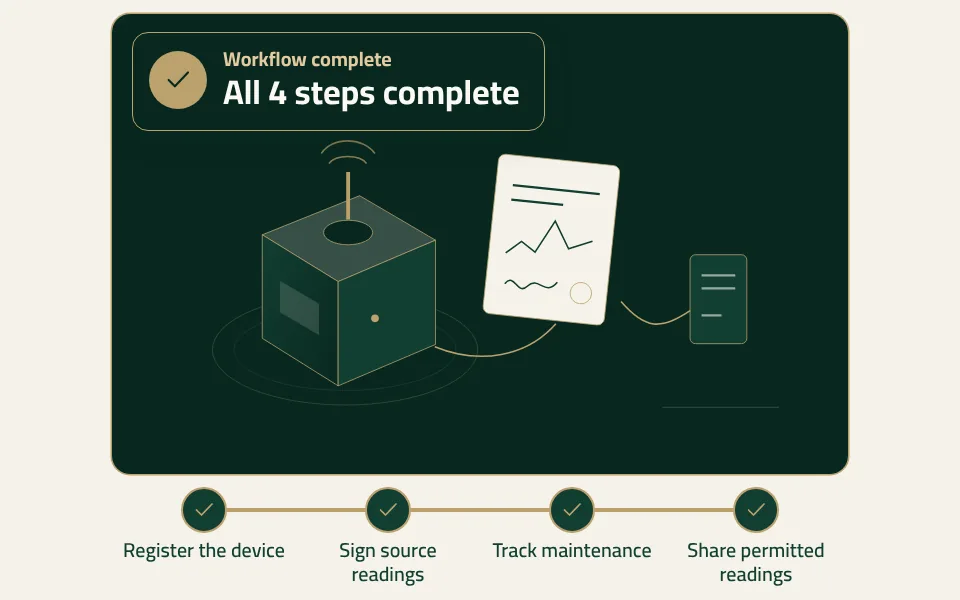
- Register the device
- Sign source readings
- Track maintenance
- Share permitted readings
How the record holds together
- Device
- Calibration
- Reading
Who this is for
Utilities, fleet and logistics operators, smart-building managers, manufacturers and device makers.
The operational challenge
When sensor data drives billing, safety or compliance decisions, operators must prove which device produced it and that it was calibrated and untampered.
A proposed workflow
- Step 01
Register the device
Register each device with a cryptographic identity at commissioning.
- Step 02
Sign source readings
Sign critical readings and alerts at the source.
- Step 03
Track maintenance
Record calibration, firmware and maintenance events.
- Step 04
Share permitted readings
Share verifiable readings with customers, insurers or regulators.
What is recorded
Device identity, ownership, calibration and firmware history, and fingerprints of critical readings.
Who verifies
Operators and auditors check signing identity, calibration evidence and reading time separately. A valid signature cannot prove an accurate sensor; implausible readings and compromised keys need human review.
Telemetry data governance
Keep high-volume telemetry in controlled storage. Evaluate minimal event proofs only where useful, and assess location or behavioural leakage even from fingerprints. Define retention and permitted recipients.
Integration to evaluate
Plan gateway and asset-system interfaces, key rotation and device retirement. Test clock drift and replacement devices, keeping evidence exchange separate from equipment-control commands.
Continue the journey
FAQ
Questions, answered
Does every reading go on a blockchain?
No. The proposed design keeps routine telemetry private and evaluates limited proofs only where justified. Device ingestion and anchoring need separate implementation and validation.
What happens if a device is replaced?
The old identity is retired and the new device is linked to the same asset, keeping the history continuous.
YOUR NEXT STEP
Build your next step
on trust.
Find the right starting point for your assets, records and business.
Find your use case